HRN 373: IMPROVING Citizen Weather from the 2017 DCC

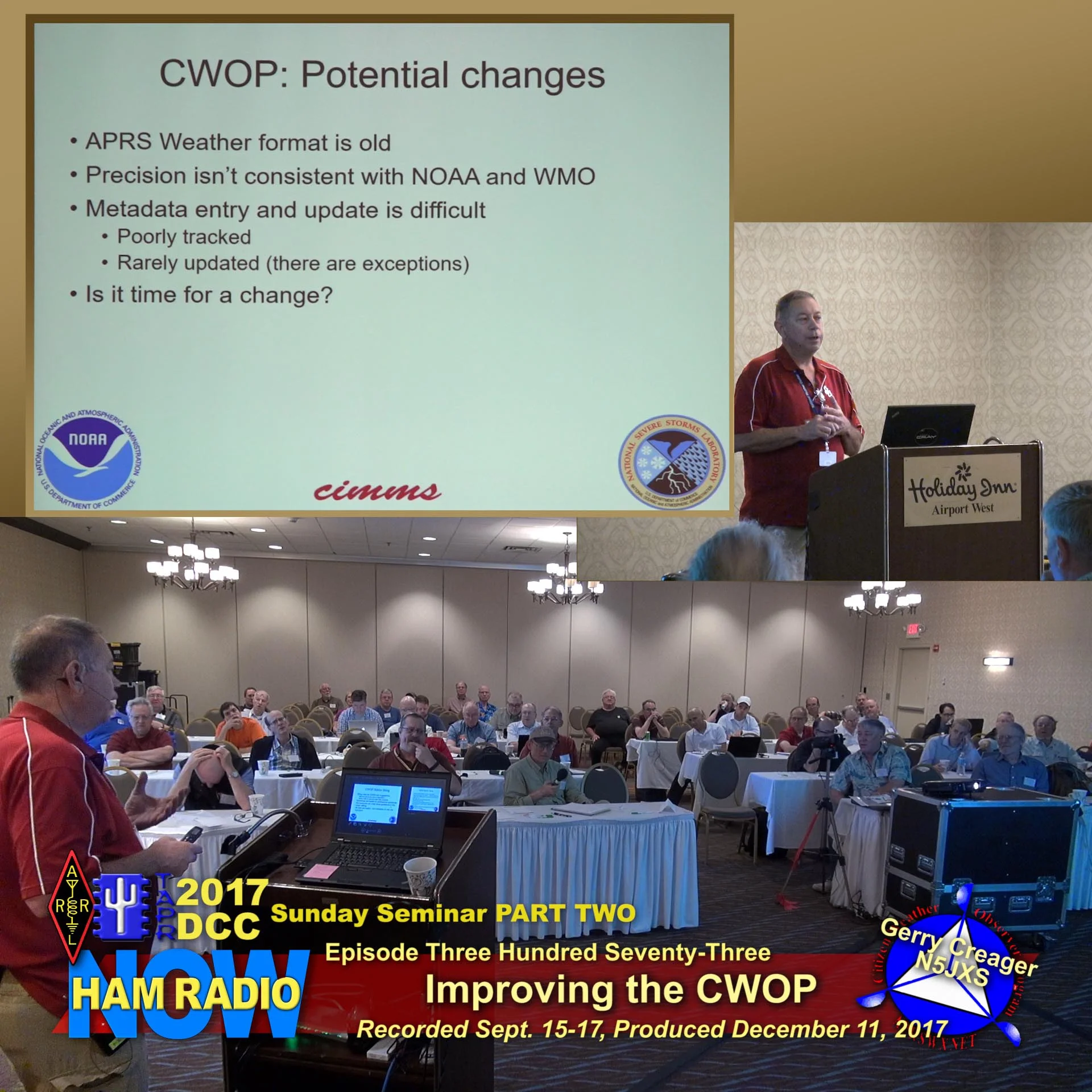
This is Part Two of the Sunday Seminar at the 2017 TAPR DCC.

Part One was in HRN Episode 372 (immediately preceding this episode), and both are on the topic of the Citizen Weather Observer Program - all those weather stations that you and your friends have.

In Part One, Gerry Creager N5JXS described the station components, what data they generate and how NOAA uses it, optimal positioning of the components and stuff. 

Here in Part Two, Gerry is looking to TAPR and hams to help improve the CWOP. There's a lot of detail, but it boils down to two elements:

  • Better Data
  • Lightening Reporting

These are two action items, and at the end of the talk, TAPR President Steve Bible recruited two TAPR members to lead the effort to identify what new data the CWOP needs, then figure out how to generate and forward it (APRS is a big part of data distribution, but it was never designed for this), and look into methods and maybe hardware for providing lots more rapid, detailed lightning strike data. Yes, we are making the sausage here, and you can grind some if you like.

The effort is just getting started, and as you'll hear at the end of the episode, when we produced the video, we didn't have all the contact data for hams who want to participate. We'll update it as we get it at the bottom of this episode page.

Radio Rating: B-. If you're a podcast listener, Powerpoint is not your friend (is it anybody's friend?), and there are lots of slides. Many are text headlines that Gerry covers. Some are graphs and charts that he describes fairly well, but you miss relationships. 

Links: 

PROJECT CONTACTS:

Paul Cecil KA5FPT
ka5fpt@tx.rr.com
(cell) 207-798-2107
Alt email: paulcecil@yahoo.com

Gerry Creager N5JXS
gerry.creager@noaa.gov
(C) 979.229.5301

Dave Witten, KD0EAG
2322 Deer Creek Ct,
Columbia, MO 65201

wittend@wwrinc.com
HRN 372: Citizen Weather from the 2017 DCC

The Citizen Weather Observer Program ties data from all those 'citizen' weather stations out there - the ones you see at the bigger hamfests - into the NOAA system to become part of the reporting and forecasting system. One of the guys in charge is a ham, Gerry Creager N5JXS.

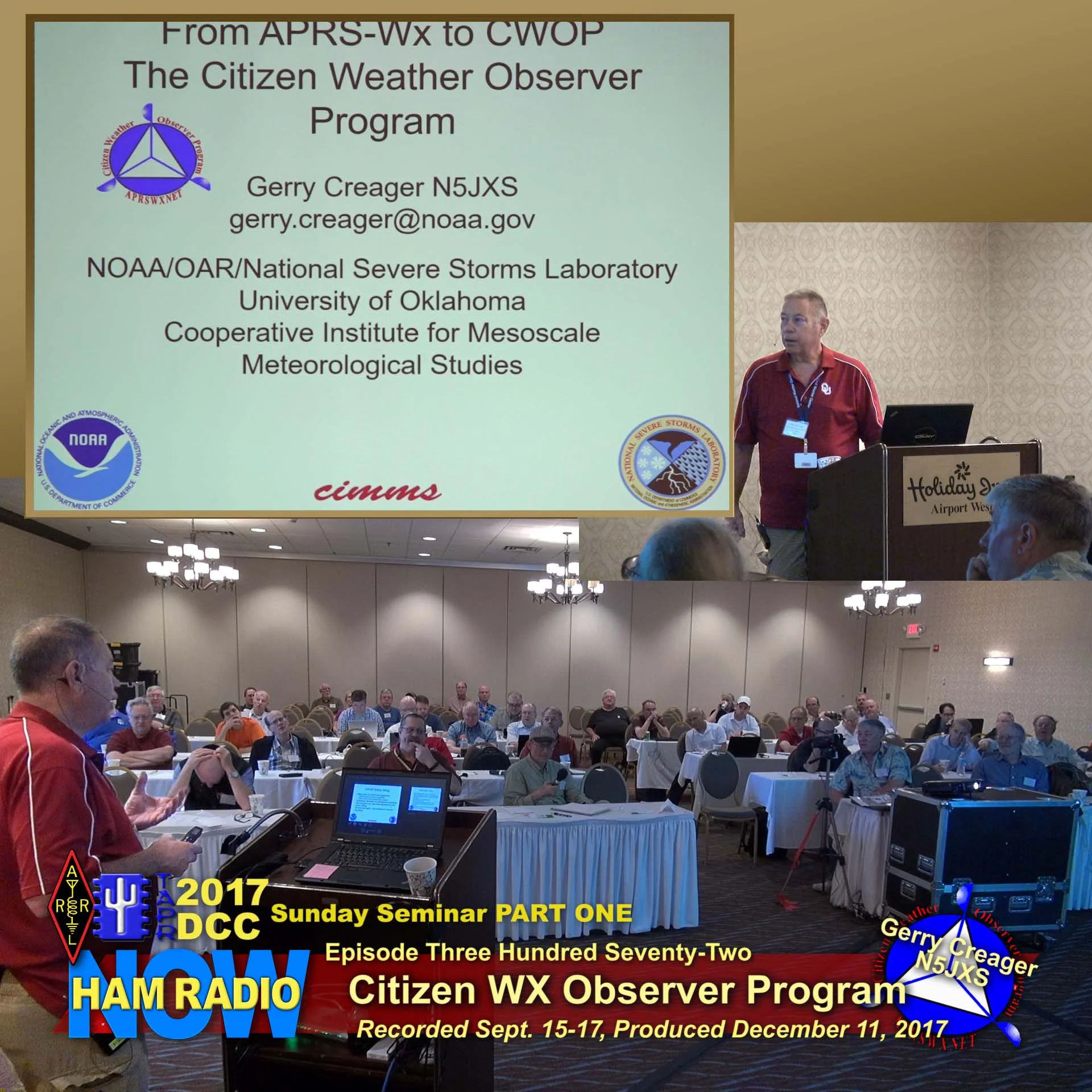
Gerry came to the 2017 ARRL and TAPR Digital Communications Conference in St. Louis to present the Sunday Seminar, the DCC's traditional Deep Dive into a single topic for four hours, closing the conference on Sunday morning.

This podcast is actually just Part One of the talk. Gerry covers a lot of ground, from what the various forms of weather stations are, to the optimum siting of the hardware, to the data supplied and how NOAA uses it.

Part Two, in the next episode of HamRadioNow, looks at possible improvements to the CWOP.

Radio Rating: C+. Gerry has lots of slides, as usual for a TAPR talk. Many are just text headlines, but there are some pictures (especially when he's talking about siting the hardware), and some charts. Most of the time he describes what's in slides well enough to get the idea. But you know, P=1kW.

Links: 

HRN 371: Where Never Is Heard (And the Bands Are All Open All Day)

Our cryptic title refers to the ARRL Code of Conduct for Directors, initiated in January 2017, that contains multiple provisions requiring Directors to support League positions even if they personally disagree, and not publicly speak against them. 

This program brings CQ editor Rich Moseson W2VU, blogger and podcaster Dan Romanchik KB6NU and blogger and podcaster Sterling Coffey N0SSC together with hosts David W0DHG and Gary KN4AQ for an in-depth discussion of the Code of Conduct and the underlying issues with the ARRL Board. 

We talk about how the Board has apparently been systematically removing 'disruptive' members by finding ways to keep them from running for re-election (Doug Rehman K4AC [former SE Div Director], Bob Famiglio K3RF [EPA Vice Director, seeking to run for Director]), and how we predict that will happen to current SW Div Director Dick Norton N6AA following his censure by the Board for allegedly speaking out against the Code of Conduct at the Visalia International DX Conference in April 2017.

CQ's December editorial, ARRL: Circling the Wagons, and a White Paper with even more details on what's happening at the ARRL Board, will be online soon at the CQ web siteCQ's January editorial will focus on the Code of Conduct itself.

Dan Romanchik KB6NU's blog post - What the heck is the ARRL Board thinking? - on Dick Norton's censure contains comments from prominent hams who were there and said that Dick spoke about the Code of Conduct, but not against it. The minutes of the meeting where the Code was approved show that Dick and two others Board members voted against it.

The Directors most vulnerable to criticism for their support of the Code are the ones up for re-election next year (assuming they choose to run again). They are (courtesy of N0SSC's Blog):

  • Kermit Carlson W9XA (Central Division, member of the now-infamous Ethics & Elections Committee and maker of the censure motion)
  • Mike Lisenco N2YBB (Hudson Division, member of the Executive Committee and the one who seconded the censure motion)
  • Tom Frenaye K1KI (New England Division and member of  the Ethics and Elections Committee)
  • Jim Pace K7CEX (Northwestern Division and member of the Ethics & Elections Committee)
  • Jim Boehner N2ZZ (Roanoke Division).

Links: 

Radio Rating: A++. We do show the text of the documents, blog posts and web sites, and a very few pictures, but we read all the pertinent parts. Otherwise, talking heads.

And for what it's worth, while the show clocks at about 2 hours, the pointed discussion is about 90 minutes. The last 30 minutes is our post-show confab (aka "the best part of the show").